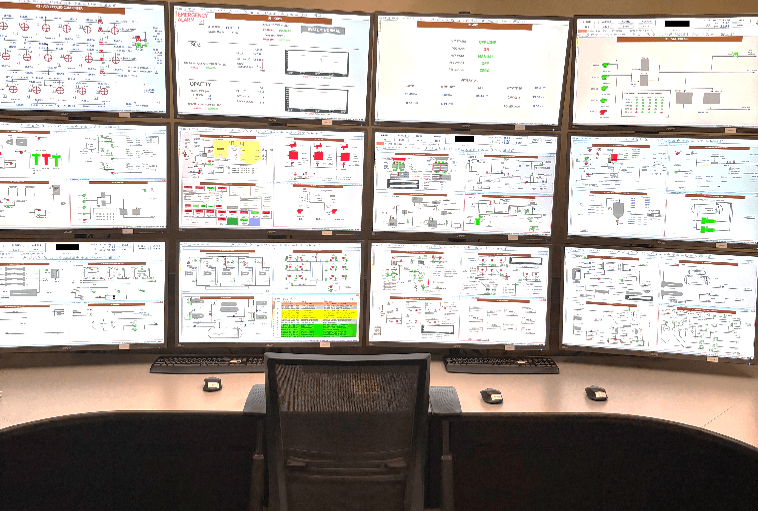
TRAX delivered the Neil Simpson Complex (NSC) Generating Station Unit 3 (Wygen Unit 1) training simulator with Black Hills Energy.
Black Hills Energy delivers natural gas and electric utility services to customers in the Midwestern United States. They maintain a strong commitment to planning for the future and investing in infrastructure and systems to support their generating assets. TRAX was pleased to be chosen to provide this training simulator in support of that mission.
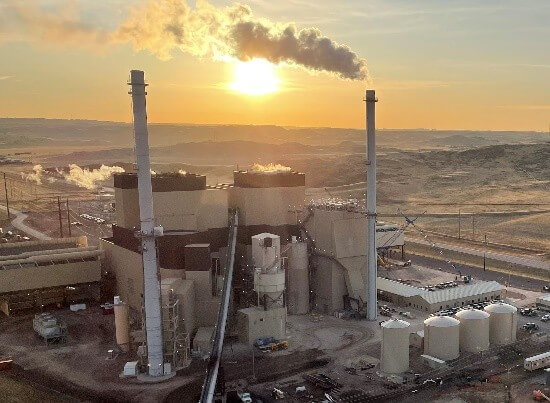
Nearly every power plant simulator presents a situation that challenges our modeling assumptions or gives us an opportunity to model an unconventional arrangement. Wygen Unit 1 is a small (94 MW) coal-fired drum boiler unit. The Neil Simpson Complex is located in the Powder River Basin, a high and dry location with no nearby body of water for cooling. This means that the unit uses air-cooled condensers for turbine exhaust rather than the water-based arrangements more common elsewhere. In addition, due to the size of the unit, there is only one induced draft (ID) fan and one forced draft (FD) fan.
Like Black Hills Energy, TRAX likes to prepare for the future by investing in our ProTRAX simulation software. Thanks to a previous development effort, TRAX was able to fully model the NSC configuration with existing software components, from FD fan to emission control scrubbers and selective catalytic reduction (SCR) controls.
Development for the simulator included the simulation of the ABB 800xA Operator Interface, development of GE MarkVI turbine control screens, sootblower control screens, emissions monitoring display, hard panel emulation, and local operations screens.
TRAX was also able to conduct much of the NSC simulator testing remotely, which improved schedule flexibility and reduced travel time for critical operators, plant personnel, and engineers.
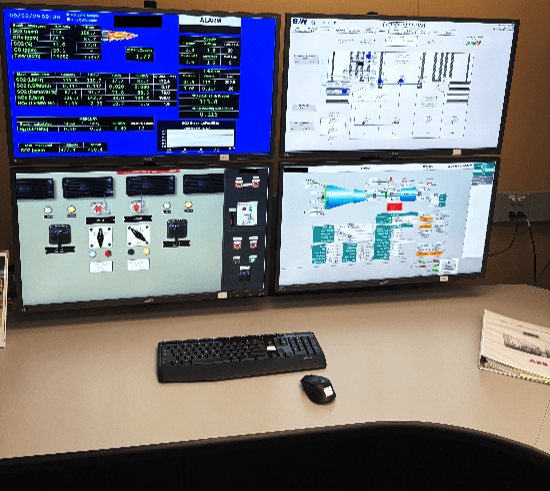
TRAX simulators come with a host of built-in training tools that can help operators create and use customized training scenarios, including features like standard malfunctions and trend files.
Power plant simulation training plays a crucial role in safe, efficient operation. By engaging in simulated scenarios, operators can familiarize themselves with complex systems and practice problem-solving techniques during normal and abnormal operating situations. With time and training, operators can increase operational efficiency, reduce downtime, and ensure a safe working environment. Investing in this form of training is essential for maintaining high standards of performance and safety within the power generation industry.
TRAX has delivered a carbon capture simulator for a 150 MW coal-fired unit that models the capture of the full flue gas stream. The system provides both CO2 and SO2 capture, delivering the captured CO2 to a pipeline for industrial use and underground storage.
—CO2 and SO2 capture
—Sulfuric acid plant
—CO2 and SO2 amines filtration and purification
—CO2 compression
—CO2 pipeline and cavern
As shown below, TRAX built a modular simulation replicating the plant layout using our software, ProTRAX. ProTRAX contains a full suite of modules specific to carbon capture functions and can model a wide variety of processes. TRAX also virtually replicated the user interface that appears in the plant.
Upon initial delivery, the TRAX simulator was used to debug control logic and processes prior to site installation and to provide operations training prior to plant startup. There was a clear need to begin training operators as early as possible since they had multiple unfamiliar systems to learn.
Thanks to the ProTRAX simulator, our customer gained considerable insight into control functionality and system interactions, resulting in modification to some control logic and correction of simple errors. TRAX was able to assist with controls tuning, and helped in development of initial plant Operating Procedures.
The latest upgrade brings the model into alignment with the as-built plant condition by updating and tuning the simulator models to match the current plant dynamics. In addition, TRAX has updated the simulator controls and HMI graphics to the as-built state. Keeping the simulator aligned with the current plant condition is critical to maintaining a positive training value, and is of paramount importance to the customer.
.png)